
Robot data · Hand force · Robot learning
Hand data that teaches robots how hard to hold.
Robots learn hand skills from people. Cameras show where the fingers go, but not how hard they press. We are building data gloves that record touch and force alongside motion and video, and a service that turns those recordings into robot-ready training data.
How a recording works
A skilled worker does the job; we record every detail
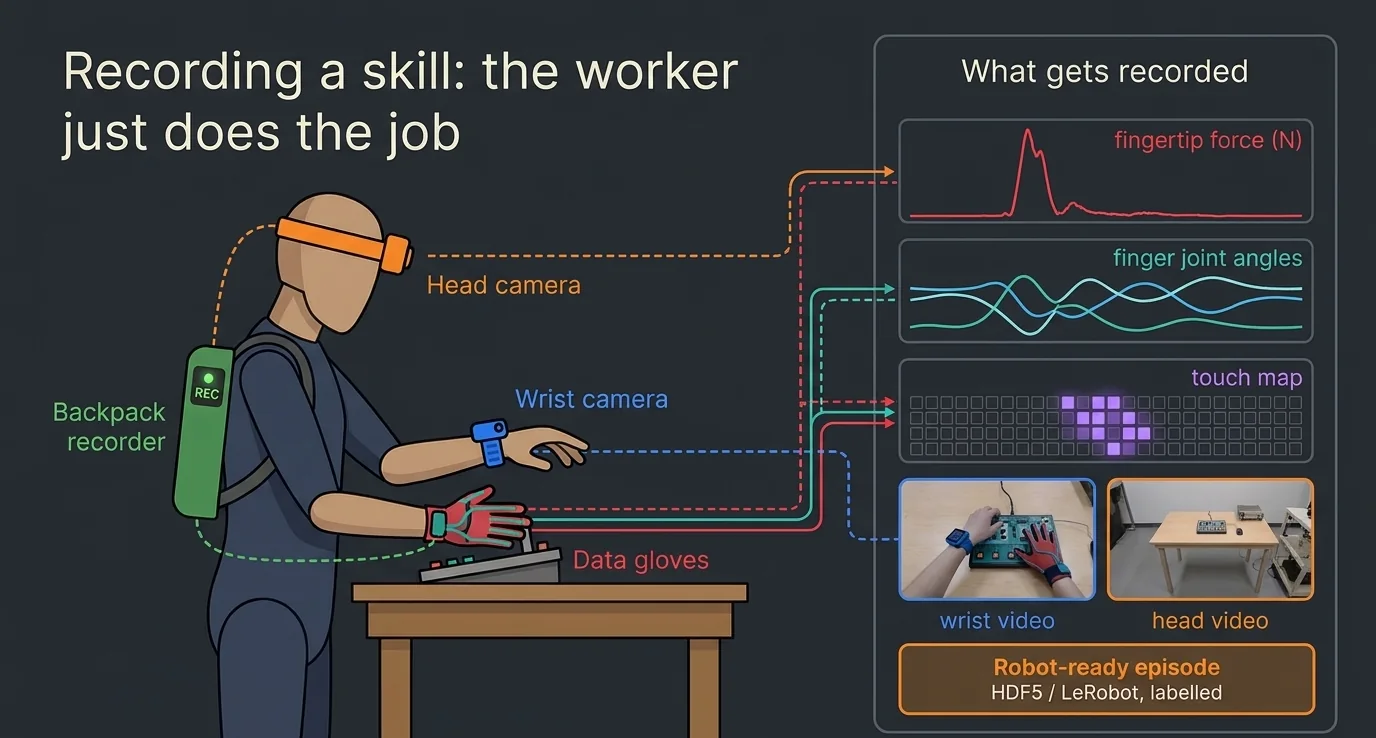
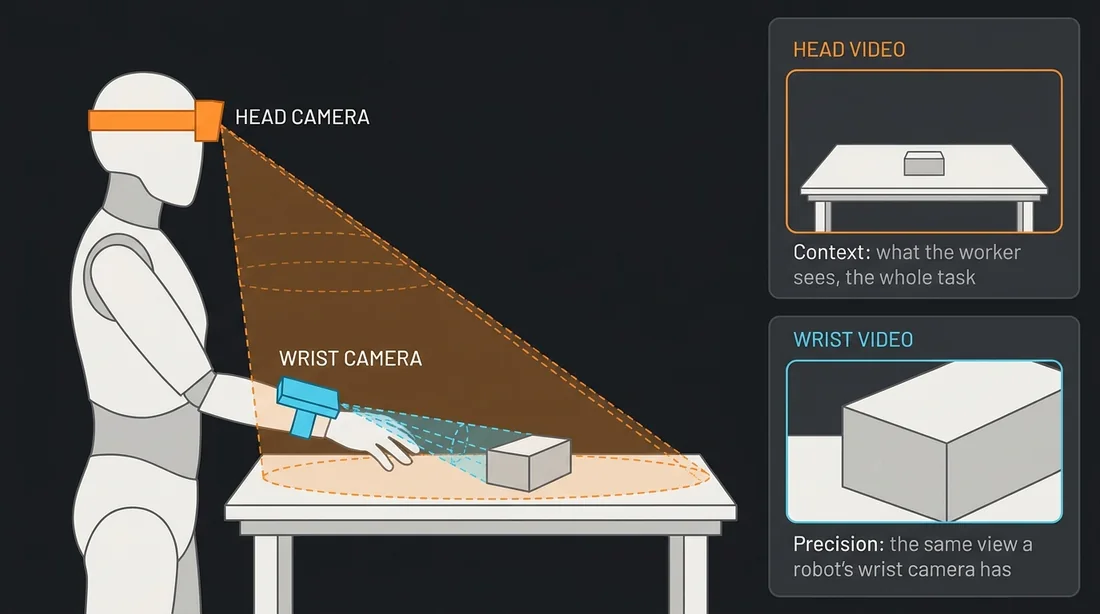
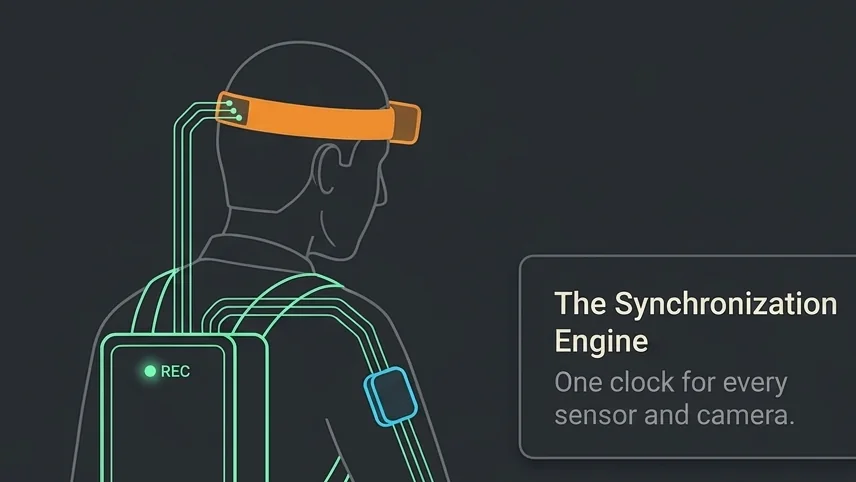
The worker wears a head camera, data gloves, a wrist camera and a small backpack recorder, then simply does the task as usual: picking screws, plugging cables, assembling parts. Every sensor and camera is stored on one clock, so a robot can later learn what the person saw, how their fingers moved and how hard they pressed.
Two ways to record a hand
Data without force, and what it misses
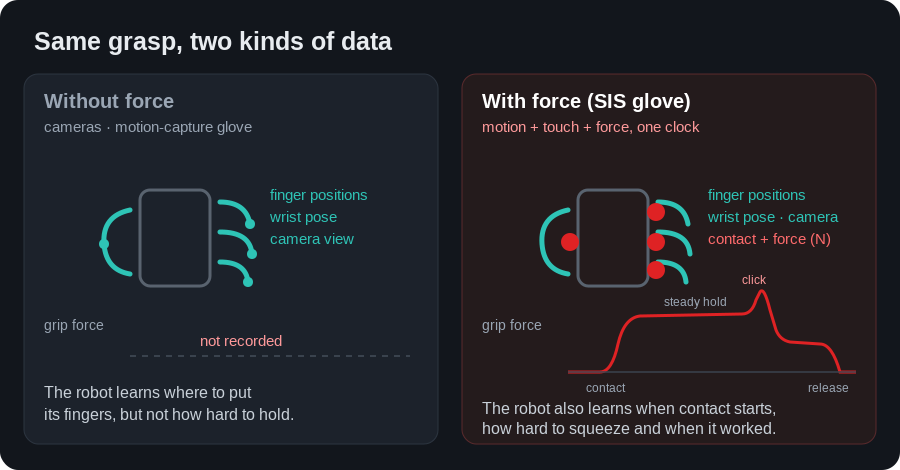
Most hand data for robots today is recorded with cameras, motion-capture gloves or wrist trackers. These give accurate finger positions and a view of the scene, and they are a strong way to teach a robot where to put its hand. What they cannot record is the force the person used.
| Without force | With force | |
|---|---|---|
| What is recorded | Finger positions, wrist pose, camera images | All of that, plus contact, touch location and force in newtons |
| What the robot learns | Where to move and how to shape the hand | Also how hard to squeeze, when contact starts and whether the step worked |
| Hidden fingers | Cameras lose fingers behind objects; gloves and trackers keep them | Touch sensors report contact even when nothing can be seen |
| Typical struggles | Holding something steady, tool use, pushing a part home | Built to capture exactly these moments |
What published research shows. In DexCap (Stanford, 2024), a wearable motion-capture system without force sensing, robots trained only on human hand data handled pick-and-place well. They struggled where force matters: the authors report trouble steadying a box during packing because force was not captured, and tool tasks such as scissor cutting only worked after extra human corrections on the real robot.
Our data gloves
V1 and V3: force first, then full touch
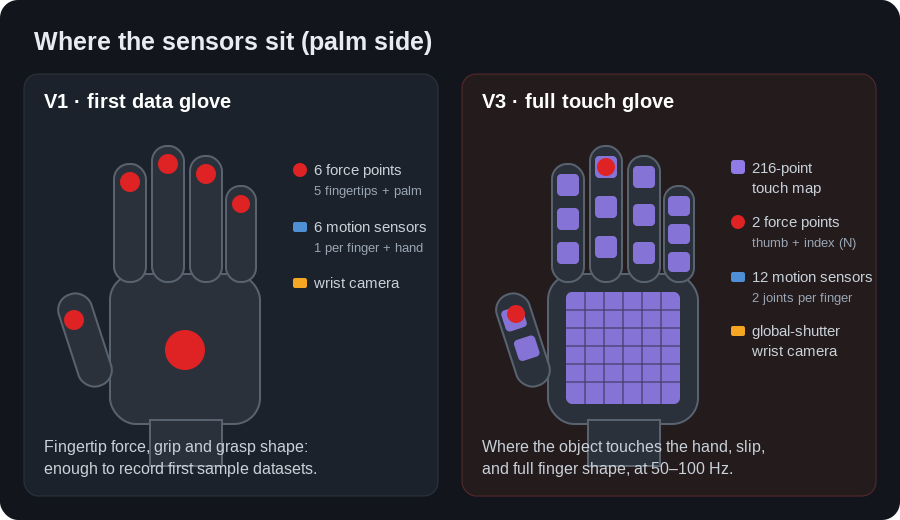
We are designing two gloves, built in Pakistan from parts we can source and repair locally. V1 records the essentials quickly; V3 adds a full touch map and finer finger motion. Both record on one clock with a wrist camera and a head camera.
V1 data glove In development
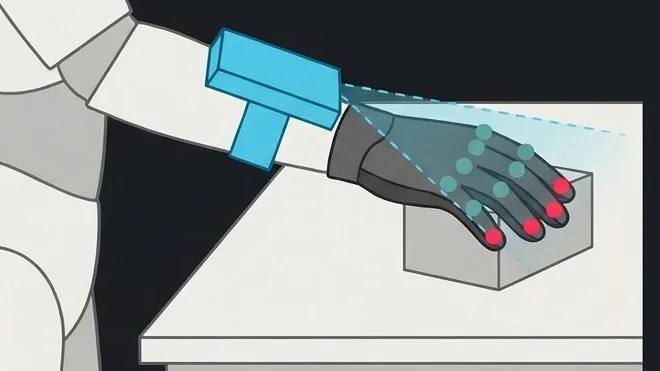
Six force sensors on the fingertips and palm, a motion sensor on each finger and the back of the hand, and a wrist camera. It records fingertip force, grip type and grasp shape at 100 readings per second: enough for first sample datasets.
V3 touch glove In design
A 216-point touch map over the palm and every finger segment, two calibrated force points on the thumb and index finger, twelve motion sensors for two joints per finger, and a sharp global-shutter wrist camera. It shows where the object touches the hand and catches slip before a drop.
| V1 | V3 | |
|---|---|---|
| Force | 6 points: 5 fingertips + palm, in newtons | 2 calibrated points (thumb, index) on top of the touch map |
| Touch map | — | 216 points over the palm and all fingers, 50 times per second |
| Finger motion | 1 bend per finger + hand orientation | 2 joints per finger + hand and forearm reference |
| Wrist camera | Compact camera, about 15–20 frames per second | Global shutter, 30–60 frames per second, sharp in fast moves |
| Recorder | Laptop in the studio | Belt recorder, so the wearer can move freely |
| Best for | First datasets, grip and contact timing | Contact-rich tasks, slip, in-hand adjustment |
What you receive
Robot-ready episodes, not raw files
Each demonstration is one episode in HDF5 or LeRobot format, ready for common robot-learning methods such as ACT, Diffusion Policy and vision-language-action models.
- Force in newtons and normalised touch maps
- Finger joint angles and hand orientation
- Wrist and head video aligned to the sensor clock
- Task steps, contact moments and success labels
- A datasheet: sensors, units, calibration and consent
- A viewer that plays video, force and finger angles together
Quality targets we work to
| Measure | Target |
|---|---|
| Glove-to-video timing | Within one video frame (33 ms) |
| Dropped sensor readings | Below 0.5% per episode |
| Force accuracy | Within about 10% of known weights |
| Finger angles vs video tracking | Within about 10° |
| Labels checked by a person | 100% of step and success labels |
How we work
From a person's hand to a robot policy
- 01
Consent & setup
Written consent from every person recorded, agreed rules on what may be filmed, then the glove and cameras are set up at the station.
- 02
Calibrate & record
A one-minute calibration with known weights and hand poses, then the task is done naturally; a light flash marks the start of each recording.
- 03
Check & label
Automatic checks for timing, dropped readings and blur, automatic contact and step labels from the force signal, then a human review.
- 04
Package & validate
Faces blurred, files packed as robot-learning episodes with a datasheet, a baseline policy tested in simulation, and private delivery.
Our approach
Depth and proof, not just volume
Large data vendors compete on hours of video. We focus on what is hard to get: calibrated force and touch, small custom batches delivered quickly, and evidence that the data trains a robot. Our simulation facility, which already runs robot arm models such as SO-101, OpenArm and UR5e, is where that evidence comes from.
Annotation and quality checks
We label your existing robot or first-person hand videos: task steps, contact moments, success or failure, hand pose and objects, with every label checked by a person.
Custom data collection
Your tasks, recorded by trained people wearing our force glove, at a workshop or in our studio in Karachi. The data is yours alone.
Hand-skill library
We are building a set of common workshop tasks, such as plugging cables, tightening screws and placing parts, recorded with force, to offer as a ready-made dataset.
Robot-validated data
For each dataset we train a baseline robot policy and show it working in our simulation facility, so you can see the data is useful before you scale up.
People first. Everyone we record gives written consent in Urdu or English, knows the data trains robots, is paid fairly by the hour and can stop at any time. Faces are blurred and no personal or confidential details stay in the files.
Need hand data with force for your robot?
Tell us the task, the robot hand and how many demonstrations you need. We'll propose a pilot.
Discuss your data needsDexCap is a research project of Stanford University, cited here from its published paper; SO-101, OpenArm, UR5e, ACT, Diffusion Policy and LeRobot are projects or products of their respective owners. Soft Innovative Systems is not affiliated with them. Illustrations on this page show the recording setup and are not photographs.