
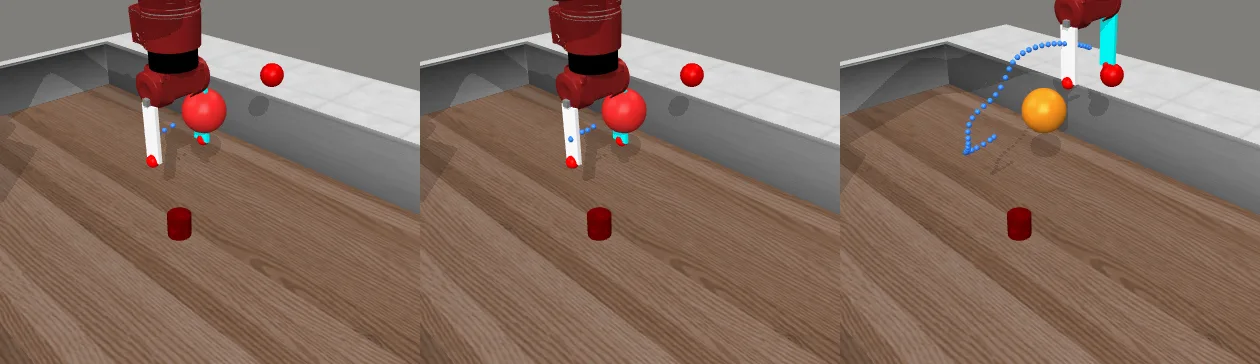
When a robot arm drops a part, the usual response in robot learning is the same every time: collect the failure videos, have people label them, add them to the training set and retrain the policy. It feels like progress. Often it is not, because retraining only fixes one of the four reasons a robot fails.
At Soft Innovative Systems we think the most valuable step comes before retraining: find out which part of the robot caused the failure, and in which phase of the task it started. Then fix that part, and retrain only when the policy really was at fault.
Four reasons a robot fails
Every moment of a manipulation task passes through a chain of four steps, and any one of them can break:
- Perception. The robot's picture of the world is wrong: a camera has drifted, glare hides an edge, a transparent object is invisible to depth sensing.
- Policy. The robot saw the world correctly but chose the wrong action, usually in a situation its training data never covered.
- Hardware. The right command was sent, but the arm did not carry it out: servo delay, backlash, a torque limit, an overheating motor.
- Contact. The arm did what was asked, but the object behaved differently: it was wetter, heavier or more slippery than expected.
Each one needs a different fix, and only one of those fixes is new training data.
Why the causes are hard to tell apart
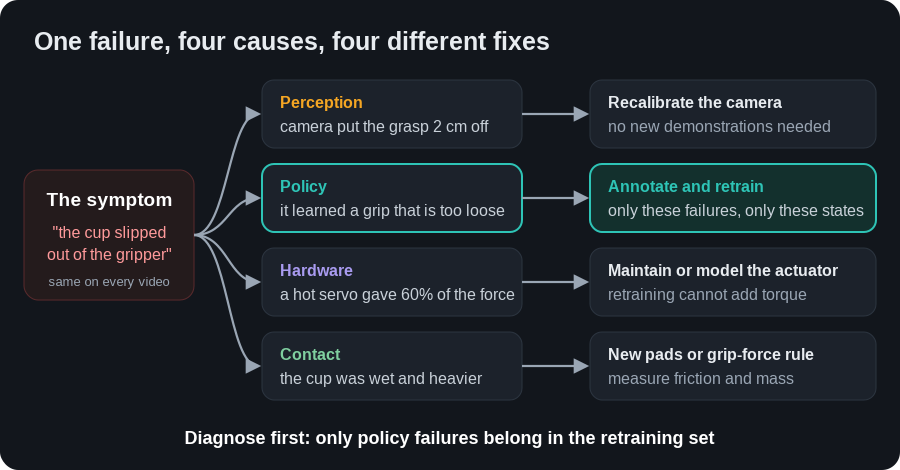
A cup sliding out of the gripper while it is being carried looks identical on video whether the camera placed the grasp off-centre, the policy learned a loose grip, a hot servo delivered too little force or the cup was simply wet. An annotator watching the clip cannot see the difference, so a label such as "bad grasp, add more demonstrations" is a guess.
It gets harder because of timing. A pick-and-place task has five phases: reach, grasp, lift, move and place. A fault that starts during the reach often only becomes visible during the move. The phase where you see the failure is frequently the wrong place to look for its cause.
Why retraining on everything does not work
If every failure goes back into the training set, the policy is asked to solve problems that are not its own:
- It learns to aim slightly off-target to make up for a miscalibrated camera, and breaks again the day the camera is fixed or the policy moves to another robot.
- No amount of data adds torque to a weak motor or removes latency from a servo.
- Labelling hours are spent on failures that an engineer could have fixed in an afternoon, while the same failures come back after the new model ships.
The result is a slower, more expensive improvement cycle, and a policy that has quietly learned the wrong lessons.
What our simulation tests show
We tested this in our own simulation facility. We re-implemented a published fast-replanning diffusion policy (RA-DP, IROS 2025), which updates its plan at every control step, and deliberately injected faults of each kind into each phase of a pick-and-place task.
- Fast replanning absorbed hardware faults. When actions arrived late or with only half the motion, the replanning policy corrected itself at the next step and kept 96–100% of its successes, against 87–100% for a standard diffusion policy.
- Nothing absorbed a perception fault during the reach. A 3 cm error in where the robot thought the object was removed about 90% of successes for both policies. They replanned perfectly, towards the wrong place.
The lesson is direct: a better policy cannot fix a wrong input. If that perception failure had been labelled and added to the training set, the team would have spent annotation time and compute for no gain.
How we diagnose a failure
We combine several tests, each designed to answer one question:
- Did the arm do what it was told? Commanded and measured joint motion, delays and motor current reveal hardware faults directly from the robot's logs.
- Would correcting every step have saved it? Replaying the failure in simulation with a fast-replanning controller separates execution faults from decision faults.
- Was what the robot saw wrong? An independent estimate of where the object really was, from a second view or from where the fingers touched it, shows perception errors that the robot's own log hides.
- With the same view, was a better action possible? A planner that sees exactly what the policy saw tells policy mistakes from perception mistakes.
- Would normal friction and mass have saved it? Replaying the episode with the object's properties set back to normal isolates contact problems.
The outcome for each failure is a category, the phase where it started and the evidence behind it, so an engineer can check the reasoning rather than trust a label.
Then we retrain, but only what needs retraining
Once failures are sorted, each goes to the fix it needs. Perception failures go to calibration or perception fine-tuning, hardware failures to maintenance or an actuator model, contact failures to grippers, pads or measured friction ranges. Only the policy failures go to annotation, and only the states where the policy went wrong need new demonstrations or corrections. We then retrain the policy in simulation, test it again in scenes it has not seen, and only then move to the real robot.
For a team running a fleet of manipulators, this turns hours of manual labelling into a short, targeted set, and turns a vague "it failed again" into a ranked list of what to fix first.
Why SIS
Soft Innovative Systems has built training simulators since 2007 and has delivered more than 350 of them. Every one of those systems joins software with real sensors, actuators and mechanical parts, and every one had to be debugged by working out whether a fault lived in the electronics, the mechanics or the code. That is the same discipline robot learning now needs.
- Hardware and software together. Our engineers instrument systems, read telemetry and separate hardware faults from software faults as daily practice.
- Our own simulation facility. Real-time physics in MuJoCo for testing, NVIDIA Isaac Lab for training, and realistic scenes for replaying failures.
- Robot learning in practice. We re-implement and test current research, from diffusion policies to interactive imitation learning, and report honestly where results differ.
- Perception and people. Our work covers camera and lidar perception and human-robot interaction, including detecting when a person is confused or surprised by a robot.
Work with us
If your team builds or operates robot arms and spends hours labelling failure videos before every retraining round, send us a set of failure logs with video and joint data. We will tell you which failures belong to perception, policy, hardware and contact, which phase each one started in, and which of them are worth retraining on. See our robotics software and robot simulation work, or contact us.